DevOps
Deployments Without the Dread
If every release feels like a small emergency, the problem isn't your team. It's the absence of a pipeline built to catch mistakes before they reach production. We build the CI/CD, infrastructure, and monitoring that make shipping routine again.
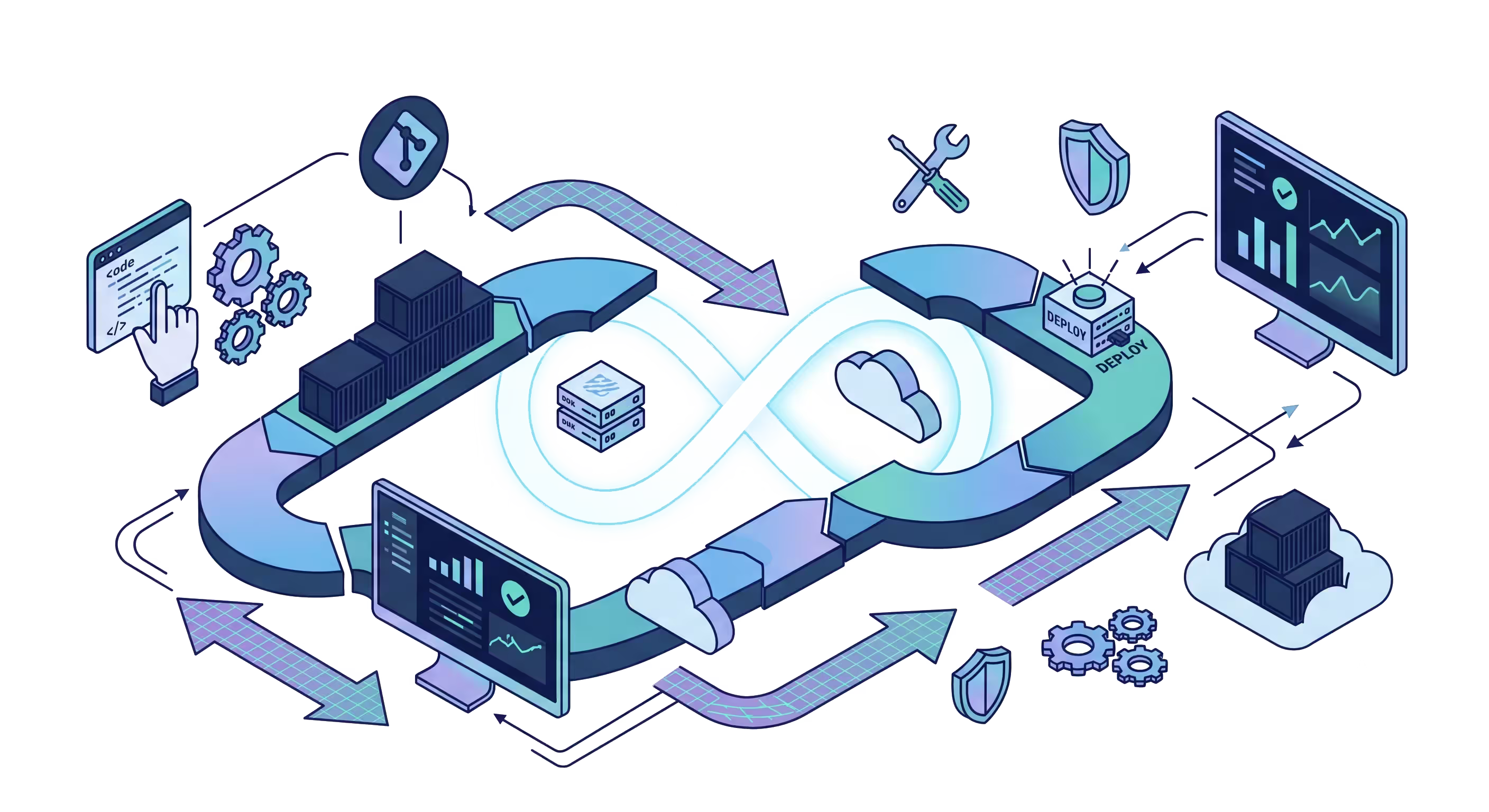
Service Overview
Everything you need to know about how this engagement creates value for your organization.
What is it?
CI/CD pipelines, infrastructure as code, and monitoring built around your existing stack, engineered to make deployments fast, repeatable, and safe.
Who needs it?
Engineering teams whose releases are manual, whose incidents take too long to detect, or whose infrastructure is defined only in someone's memory.
Business Value
Converts deployment anxiety and reactive firefighting into a predictable, monitored process your team can run without dreading it.
Key Benefits
- Automated CI/CD that turns releases into a routine, low-risk event
- Infrastructure as code that removes tribal knowledge as a single point of failure
- Containerized, orchestrated environments that scale predictably
- Monitoring and logging that catch problems before customers do
Why Are Manual Releases a Risk Your Team Absorbs Every Time?
Most engineering teams don't lack skill. They lack a pipeline that catches mistakes before they ship, and the manual gap keeps costing time and trust every release.
Every deployment is a manual, high-stakes process
Without automated pipelines, releases depend on someone remembering every step correctly, and a missed one becomes an incident instead of a footnote.
Infrastructure exists only in someone's head
Server configuration and environment setup live in one engineer's memory rather than in code, making the whole team dependent on that person being available.
Incidents are discovered by customers, not dashboards
Without proper monitoring and alerting, the first sign of an outage is often a support ticket or a social media complaint, not an internal alert.
Scaling environments takes days instead of minutes
Provisioning a new environment or replicating production for testing is a manual, error-prone task that slows down every new initiative.
Rollbacks are slower than the outage itself
Without a proper deployment pipeline, reverting a bad release takes longer than the mistake that caused it, extending downtime unnecessarily.
Releases are rare because they're risky
Teams start shipping less often to avoid the pain of deployment, which slows down the business's ability to respond to customers and competitors.
What a Proper DevOps Pipeline Actually Changes?
A well-built pipeline doesn't just make engineers happier. It changes how fast the business can respond and how much confidence customers can place in uptime.
Releases become routine, not risky
Automated CI/CD pipelines test and deploy code the same way every time, turning what used to be a stressful event into a background process.
Environments are reproducible in minutes
Infrastructure as code means a new environment (staging, testing, disaster recovery) spins up identically to production in minutes, not days.
Problems get caught before customers notice
Centralized monitoring and alerting surface issues the moment they start, giving your team a head start on resolving them quietly.
Rollbacks take seconds, not hours
A proper deployment pipeline makes reverting to the last known-good release a one-command action, cutting incident duration dramatically.
Where Does the Return Actually Come From?
DevOps investment pays back in deployment frequency, incident duration, and engineering hours no longer spent firefighting, all measurable against your current baseline.
Shorter incident duration. Automated rollback and monitoring cut the time between something breaking and it being fixed.
More frequent, lower-risk releases. Automated pipelines let your team ship smaller, safer changes more often instead of large, risky batches.
Reduced key-person dependency. Infrastructure as code documents your environment in a repository, not in one engineer's memory.
Faster new environment setup. Reproducible infrastructure turns a multi-day provisioning task into a scripted, minutes-long process.
Fewer engineering hours lost to firefighting. Proactive monitoring frees your team to build product instead of chasing undetected issues.
How Does the Engagement Actually Run?
The same disciplined process behind every project, applied to this one.
Current State Assessment
We audit your existing deployment process, infrastructure, and monitoring gaps before recommending any change.
Pipeline & Architecture Design
We design the CI/CD pipeline and infrastructure-as-code approach matched to your stack and team's workflow, not a generic template.
Implementation in Stages
We build and roll out incrementally (starting with the highest-risk gap) so your team adapts without disruption to ongoing work.
Monitoring & Alerting Setup
Centralized logging, monitoring, and alerting are configured so your team has visibility from day one, not just after the first incident.
Team Handoff & Ongoing Support
We document everything and train your team on the new pipeline, staying on to support it as your infrastructure evolves.
What Actually Happens During the Engagement
No black box. Here's what you're involved in, and what you're handed at the end.
- A documented assessment of your current deployment and infrastructure gaps
- CI/CD pipelines configured for your actual codebase and release cadence
- Infrastructure defined as code, version-controlled and reproducible
- Centralized monitoring, logging, and alerting wired into your team's existing tools
- Containerization and orchestration where it fits your workload, not by default
- Documentation and hands-on training so your team owns the pipeline going forward
What's a Realistic Timeline?
Scoped ranges, not vague promises. The exact plan is confirmed after discovery.
Assessment
3–5 daysAudit of current deployment process, infrastructure, and monitoring gaps.
Pipeline Design
1 weekCI/CD and infrastructure-as-code architecture matched to your stack.
Implementation
2–5 weeksStaged rollout of pipelines, infrastructure code, and monitoring.
Handoff & Training
1 weekDocumentation, team training, and a transition to ongoing ownership.
What Technology Is Behind It?
We pick the right tool for the outcome, not the newest one for its own sake.
CI/CD
Infrastructure as Code
Containers & Orchestration
Monitoring
What Results Have We Delivered in DevOps?
Real outcomes from devops engagements, not manufactured claims.
A growing fintech engineering team
Releases were manual, deployed by a single senior engineer who understood the server setup, with no monitoring to catch issues before customers reported them.
We built an automated CI/CD pipeline, moved infrastructure into version-controlled code, and set up centralized monitoring and alerting.
Deployments no longer depend on one person, releases ship more frequently with less risk, and the team now catches issues before customers notice them.
Related Services
Capabilities that pair naturally with this one.
Related Solutions
Purpose-built systems that solve adjacent problems.
Who This Is Built For
See how this looks in practice for a specific industry.
Questions About DevOps
The practical details behind how we deliver this specific service.
Not necessarily. We scope the pipeline to your team's actual size and release frequency. A lightweight CI/CD setup for a small team looks very different from an enterprise pipeline, and we won't oversell you one you don't need.
Ready to Make Deployments Boring Again?
Tell us what breaks during your releases. We'll show you exactly what a proper pipeline removes.